

Vaccine Omnibus Trials
The Origin of the Omnibus Trial
In the late 1990s and early 2000s, public concern grew regarding a potential link between childhood vaccines and autism spectrum disorder. As a result, parents of children with autism filed thousands of petitions with the National Vaccine Injury Compensation Program (NVICP).
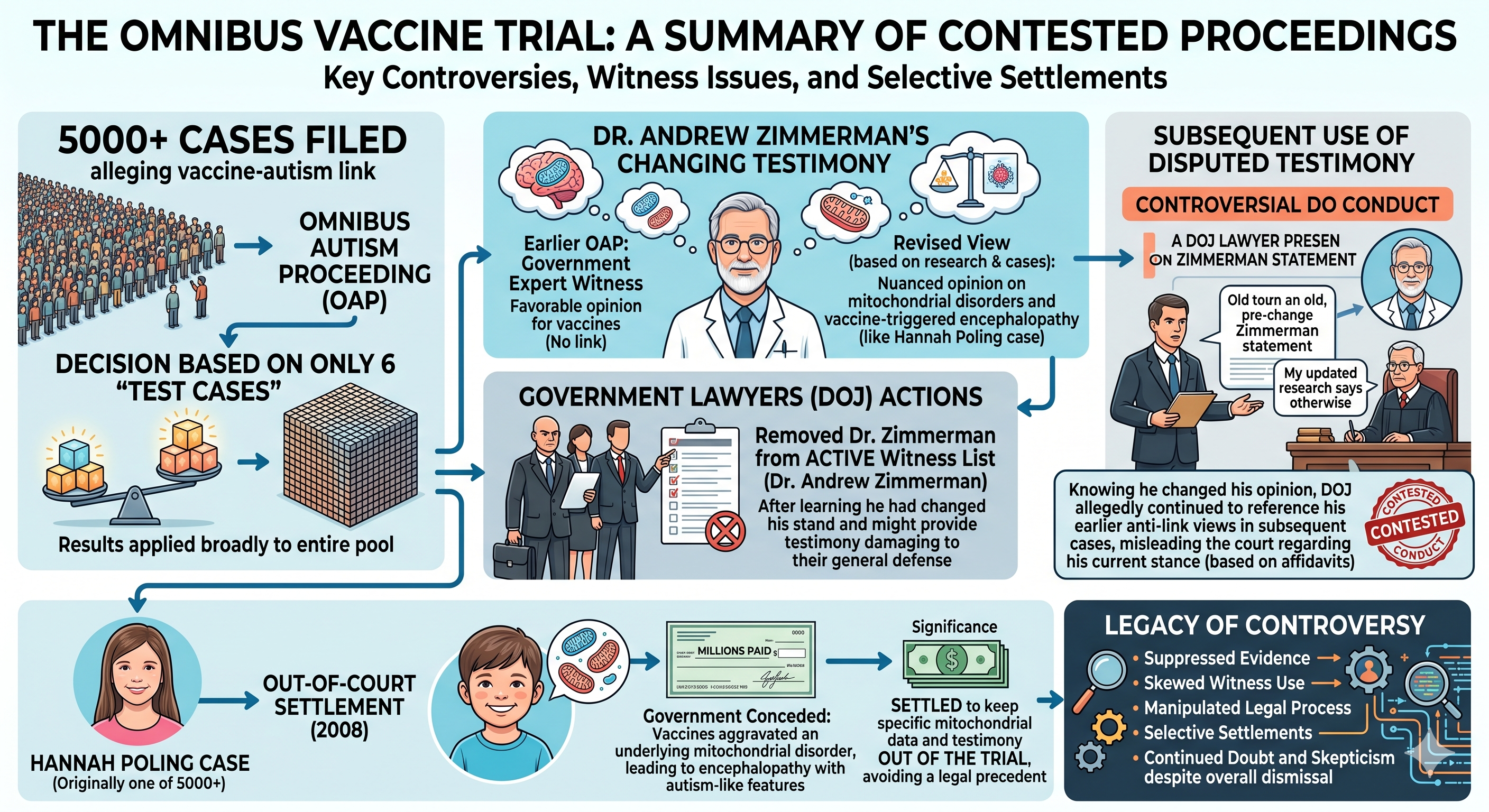
By 2002, the court was facing over 5,000 individual claims alleging that vaccines caused their children's autism.
Trying 5,000 highly complex, science-heavy medical cases individually would have taken decades and gridlocked the legal system. To solve this, the Chief Special Master of the court created the Omnibus Autism Proceeding. The goal was to pool the resources of both the plaintiffs and the government to answer the overarching question of "general causation"—whether the vaccines in question could cause autism at all.
The Test Case Strategy
Instead of looking at all 5,000 cases at once, the court asked the Plaintiffs' Steering Committee (the lawyers representing the families) to select their absolute strongest cases to serve as "test cases."
The plaintiffs developed three different theories of causation. They selected specific children whose medical histories best represented these theories:
Theory 1: The combination of the MMR (Measles, Mumps, Rubella) vaccine and vaccines containing the preservative thimerosal caused autism. The plaintiffs selected 3 test cases for this theory.
Theory 2: Vaccines containing thimerosal alone caused autism. The plaintiffs selected 3 test cases for this theory.
Theory 3: The MMR vaccine alone caused autism. (The plaintiffs eventually withdrew this theory and chose not to present test cases for it).
In total, exactly 6 test cases were brought to trial to represent the claims of the 5,000+ families.
The Trial and the Evidence
The trials for the test cases were extensive. They involved weeks of evidentiary hearings, thousands of pages of medical literature, and testimonies from dozens of world-renowned expert witnesses in fields like toxicology, immunology, neurology, and genetics.
The burden of proof rested on the plaintiffs to show, by a preponderance of the evidence, that it was "more probable than not" that the vaccines caused the autism in these specific children.
The Verdict and Aftermath
In 2009 (for Theory 1) and 2010 (for Theory 2), the Special Masters issued their rulings.
The court ruled against the plaintiffs in all 6 test cases, but the story doesn't end here. Read further below to see the trick played by the government. The rulings concluded that:
The scientific evidence heavily weighed against the theory that vaccines or thimerosal cause autism.
The expert witnesses presented by the plaintiffs often relied on speculative theories or misinterpreted medical data.
The epidemiological data overwhelmingly showed no difference in autism rates between vaccinated and unvaccinated populations.
They ruled that "Because the plaintiffs failed to prove general causation in their strongest, hand-picked test cases, the legal precedent was set". The remaining 5,000+ petitions were subsequently dismissed, effectively closing the Omnibus Autism Proceeding.
The expert witness testified in the first case that he found no causal link. In the 2nd case, however, he knew the patient himself and reversed his view. The government fired the expert witness, settled out of court with the family and used the SAME testimony in cases 3, 4 and 5, even though the witness had changed his mind.
The expert witness was Dr. Andrew Zimmerman.
Dr. Zimmerman, a highly respected pediatric neurologist, originally served as a key expert witness for the government (represented by the Department of Justice) during the early stages of the Omnibus Autism Proceeding.
During the proceedings, his professional opinion evolved based on emerging medical evidence—most notably following his evaluation of a patient with an underlying metabolic condition. He informed the DOJ attorneys that he had concluded that while vaccines do not cause autism in the general population, they could trigger encephalopathy and autism-like symptoms in a specific, rare subset of children who suffer from underlying mitochondrial dysfunction.
According to a sworn affidavit Dr. Zimmerman later signed, after he communicated this nuanced exception to the DOJ attorneys, they removed him from their active witness list and chose not to present his revised opinion to the Special Masters during the remaining test cases.
This fraud was overlooked by the "Vaccine court" special masters and still ruled against all 5,000 cases based on a technicality that the plaintiffs weren't able to prove their case.
Hannah Poling Case
The case of Hannah Poling is the Rosetta Stone for understanding why the plaintiffs feel the Omnibus trials were legally rigged. It is the exact case where the medical science and the government's legal strategy collided.
Hannah’s case was originally positioned by the plaintiffs to be one of the premier test cases for the Omnibus Autism Proceeding. Instead, it became the most famous out-of-court settlement in the history of the Vaccine Court.
The Medical Background
Hannah was the daughter of Dr. Jon Poling, a neurologist, and Terry Poling, a nurse and attorney. At 19 months old, she was developing normally. Because she had fallen behind on her pediatric visits, she received five vaccines in a single day (covering nine different diseases).
Within days, she developed high fevers, stopped eating, lost her language skills, and rapidly descended into full regressive autism.
Because her father was a neurologist, her medical workup was incredibly thorough. He discovered that Hannah had an underlying, asymptomatic cellular mitochondrial disorder.
The Government's Concession
When the plaintiffs prepared to bring Hannah's case to the Omnibus trial, the medical personnel at the Department of Health and Human Services (HHS) reviewed her files. Realizing they could not win against the hard clinical data Dr. Poling had gathered, the government abruptly conceded the case in 2008.
The government's medical concession stated that the five vaccines "significantly aggravated an underlying mitochondrial disorder," which caused a "brain energy deficit" and resulted in "encephalopathy with features of autism spectrum disorder."
She was awarded an initial lump sum of $1.5 million, plus over $500,000 per year for life to cover her care.
The Legal Maneuver
By conceding Hannah's case before it went to trial, the Department of Justice executed a highly effective legal maneuver:
Avoided Precedent: If the government had fought the Poling case in the Omnibus trial and lost, the judge’s ruling would have established "general causation" (legal proof that vaccines can cause autism in certain subsets of children). That single loss would have opened the floodgates for the other 5,000 families to claim compensation.
Sealed the Records: By settling, Hannah's case was quietly removed from the docket and sealed. It was no longer admissible as a test case.
The "Rare Exception" Narrative: The DOJ publicly framed the Poling settlement as an incredibly rare anomaly, arguing that her mitochondrial disorder made her a "one-in-a-million" exception, allowing them to continue arguing in the 6 actual test cases that vaccines were perfectly safe for the general public.
This is exactly where Dr. Andrew Zimmerman fits in. Dr. Zimmerman was the pediatric neurologist who evaluated Hannah Poling. It was his medical conclusion about her mitochondrial disorder that forced the government to settle her case. When he told the DOJ attorneys that there were likely many other children in the remaining 5,000 cases who had the exact same undiagnosed mitochondrial issue as Hannah, the DOJ removed him from their witness list to prevent him from testifying to that fact in open court.